You Are What You Eat:
Taiyuan - Nongpho Cuisine
As part of Nongpho Community International Art Festival 2024 (Baan Noorg Biennial 4)

mural painting on resident wall in Nongpho village, Ratchaburi, Thailand, cooking and gathering based on the Taiyuan recipes.
Tai Yuan food that community members still cook and eat in their households. The three dishes including Caladrum curry, fried banana blossom and Cassia curry. Especially, Caladrum curry is known as a dish that conquers masters. Due to the process requires skills because if you use Caladrum to cook without knowing how to prepare the stem, it can cause an itchy throat. The name (Gaeng Bon in Thai) is also related to the phrase “Mue Bon-Pak Bon” which means restless hands or a mouth that likes to find trouble everywhere.
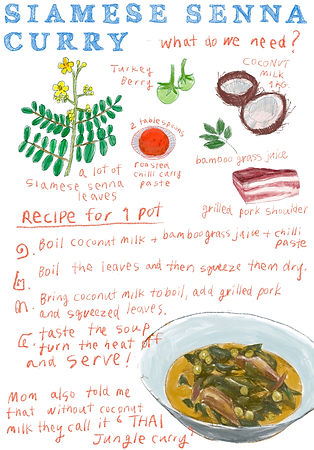


During my visit to the Nong Pho village, I had the opportunity to explore the local community's history through their traditional Tai Yuan dishes. It was fascinating to observe that these authentic recipes are not readily available in the local market or even in their daily meals. Instead, the villagers seem to have replaced them with more general dishes that have been influenced by Chinese cuisine. This shift in culinary preferences intrigued me, and I believe it raises interesting questions about the preservation and dissemination of cultural heritage. To note that there are only a few remaining individuals, mostly elderly, in Nong Pho village who are fluent in the Tai Yuan language and knowledgeable about their cultural heritage, particularly their cuisine.
This situation poses a challenge in terms of leaving concrete traces of the Tai Yuan heritage in the Nong Pho ecosystem. Considering the importance of cultural preservation, a research project focused on documenting and reviving the traditional Tai Yuan cuisine in Nong Pho village. Not only preserve the cultural heritage but they also contribute to the sustainable development of the community by promoting their unique cuisine throughout the community.


Nongpho Ecowalk:
Teacher, What is it?
To deepen our understanding of the Nong Pho ecosystem, I complemented the observation of authentic Tai Yuan cuisine in the kitchen with an exploratory walk to forage wild plants and garden vegetables woven into local ways of life.
A walk to explore and forage plants and garden vegetables through the way of life of the people in Nong Pho, Ratchaburi, Thailand.
Participants received both knowledge and experience of past and present liftestyle from Teacher Yupadee, a co- guide who was born and raised in the area since childhood and had moved away for 20 years. When returned, she saw the differences in the living that had changed on the perspectives of growing plants, eating and cooking of people in the community.
This walk offered more than a foraging activity; it was a living lesson in the community’s evolving relationship with nature and food. As we gathered edible plants around neighborhood gardens, Teacher Yupadee shared insights into local culture, explaining practices such as exchanging produce among neighbors instead of buying everything from the market—an experience that contrasts sharply with urban and central Thai food systems.
For younger generations who have not inherited this knowledge, the eco-walk provided an important opportunity to connect with traditional practices, appreciate the role of wild and homegrown ingredients, and understand the cultural heritage embedded in everyday life.

side project as part of my documentation
in Nongpho community
AIR FOOD Project 2023
> substitute cuisine
Curator, Menu documented and illustrated by:
Parichat Tanapiwattanakul
About AIR FOOD Project:
AIR Food is part of the Baan Noorg Artist in Residence (AIR) program. As life and building a thriving community in the neighborhood. Exchanging experiences in the kitchen, conversing at the dining table or roaming around the local market can be a tool to express creativity through daily life.
Thus the role of the artists’ cooking while developing their project is not only that of cultural exchange but it is also to set up a knowledge platform for the community. This can be an incredible insight for the artists to understand food culture as part of their artistic practice with the community.
The goal of AIR Food is to exchange and record knowledge on food culture with the Baan Noorg crew, the wider community in Nong Pho district and any other interested person. The cultural heritage from different areas can be experienced by cooking together, sharing homey and more complex recipes and conversing during a meal. Moreover, searching for the right ingredients or looking for substitutes can spark conversations with the local sellers and the neighbourhood.
AIR FOOD Project:
Ep. 5 Filipino Menu, Artist: Bitto
Bitto (Anjo Bolarda) is one of the artists in residence who cooked incredible Filipino meals for us. He shared many different recipes that were inspired by his family. Bitto told us that he spent most of his childhood in the kitchen and he always accompanied his parents to the morning local market. They usually cooked large portions that would last for several days and could be shared with the community. Through these experiences, he was introduced to food as a cultural heritage handed down through generations, which later on became his passion. Most importantly, some Filipino dishes are pretty similar to Thai cuisine which happens to be cooked with a lot of garlic!


